

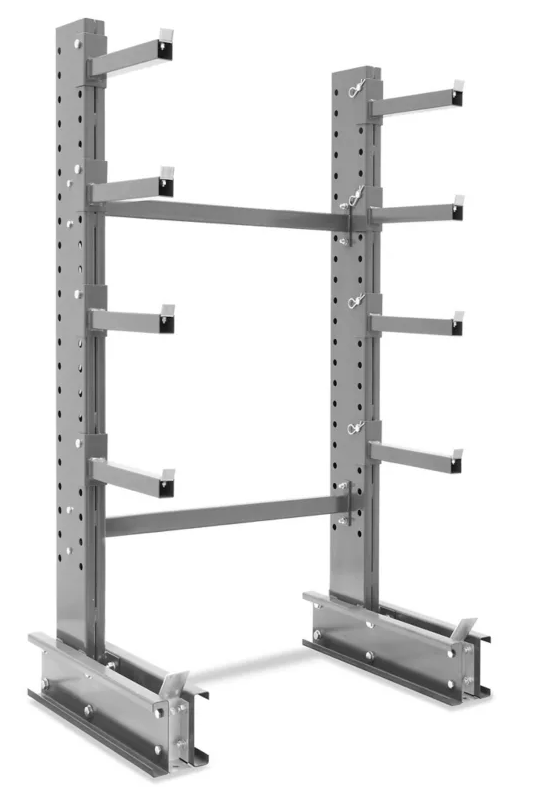
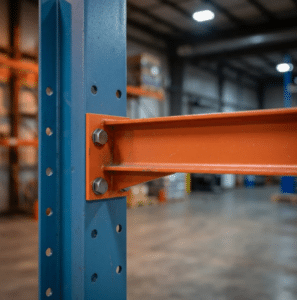
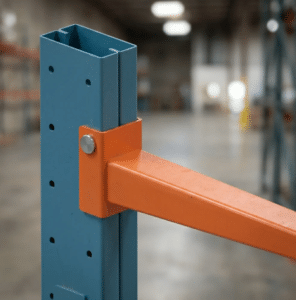
Cantilever rack is one of several storage solutions within our broader warehouse storage systems product family. It is designed to store long, bulky materials such as lumber, steel, pipe and tubing. However, not all cantilever rack is built the same way.
The two primary styles are roll-formed cantilever rack and structural cantilever rack. The biggest difference is how the steel components are manufactured and constructed. Understanding these differences can help you compare rack systems and determine which is right for your application.
Generally speaking, roll-formed cantilever rack is commonly used for lower-capacity applications, typically in the range of 500 to 5,000 pounds per arm. For applications requiring capacities above 5,000 pounds per arm, taller rack configurations or use in refrigerated warehouses, coolers and freezers, structural cantilever rack is often preferred.

Structural Cantilever Rack
Structural cantilever rack is built using structural steel sections for its primary load-bearing components. Its uprights, arms and bases are designed to provide strength and stability under demanding loads.
Uprights
Structural uprights commonly use I-beam or wide-flange steel sections. These heavy-duty steel members form the backbone of the rack system.
Arms
Structural arms are manufactured from structural steel sections designed to support specified loads. Their dimensions and ratings vary depending on the manufacturer and rack configuration.
Bases
Structural bases provide support and stability for the uprights. Their construction is designed to work with the upright and the loads carried by the system.
Connections
Structural cantilever rack commonly uses bolted connections to secure the arms and assemble the system. The exact connection design varies by manufacturer.
Roll-Formed Cantilever Rack
Roll-formed cantilever rack is manufactured by passing steel through a series of rollers that shape it into specific profiles. The resulting components are engineered for the loads and applications for which the system is designed. Construction varies by manufacturer, so not all roll-formed cantilever rack uses the same profiles or connection methods. Installation of roll-formed cantilever rack takes a bit more time vs. structural as the upright columns and bases need to be assembled on-site. The arms and brace sets are a single components and simply bolt on or are connected by a locking pin.
Uprights
Roll-formed uprights are made from shaped steel profiles rather than conventional structural I-beams. The profile design and steel specifications vary by manufacturer.
Arms
Roll-formed arms use formed-steel profiles engineered to support their rated loads. Some may resemble structural steel channels, but their cross-sections and manufacturing methods are different.
Bases
Base construction varies between manufacturers. Some use welded assemblies, while others use combinations of formed-steel components.
Connections
Roll-formed systems may use pin-style, wedge-style or other arm attachment methods. Some designs allow for relatively quick assembly and adjustment.
Key Differences at a Glance
| Feature | Structural Cantilever Rack | Roll-Formed Cantilever Rack |
|---|---|---|
| Steel construction | Structural steel sections | Steel shaped through roll-forming |
| Uprights | Commonly I-beam or wide-flange steel | Formed-steel profiles |
| Arms | Structural steel sections | Formed-steel profiles |
| Bases | Structural steel construction | Design varies by manufacturer |
| Connections | Commonly bolted | May use pins, wedges or other designs |
| Capacity | Commonly used for demanding, higher-capacity applications | Varies by design and manufacturer |
| Assembly | Typically uses bolted connections | Connection method varies by manufacturer |
One important distinction is that roll-formed cantilever rack is not a single standardized design. Manufacturers use different profiles, base constructions and arm connections, so two roll-formed systems can look and perform quite differently.
What About Cost?
Roll-formed cantilever rack can offer a lower cost, while structural cantilever rack may require a greater investment. The actual price difference depends on the manufacturer, configuration and required capacity.
The Bottom Line…
The primary difference between structural and roll-formed cantilever rack is the construction of their steel components. Structural systems use structural steel sections, while roll-formed systems use steel shaped into engineered profiles.
Neither category alone tells you everything about a rack’s strength or suitability. Always compare the manufacturer’s specifications and rated capacities for the exact system you are considering.
For help comparing options, visit Midwest Material Handling’s Cantilever Rack page to learn more about available solutions in Ohio.
