
We regularly hear from customers looking for pallet rack beam and upright capacity charts for both existing and new pallet and warehouse racking systems. This page serves as a practical reference to help estimate common load capacities based on beam length, beam height, upright column size, and overall frame design.
Understanding pallet rack capacity is important for warehouse safety, storage planning, and choosing compatible replacement components. For every new pallet rack system we supply, documented load ratings are always provided during the quoting process and again on the final invoice.
With older, existing or used pallet racking systems, exact capacities are not always available. When the original manufacturer or specifications are unknown, reference charts can still be helpful for planning, but they should never replace verified load data.
How Pallet Rack Capacities are Determined
The overall capacity of a pallet rack system is not based on one single number. It is the combined result of several components working together, including the rated capacity and design of the beams, the rated capacity and design of the uprights, and the capacity of the wire decking or shelf surface being used.
Beam and upright capacities are closely related, but they are not the same thing. Each component carries its own separate load rating, and the complete system should always be evaluated as a whole rather than by looking at only one part.
Beam and wire deck capacity ratings are typically based on an evenly distributed load, often referred to as a uniformly distributed load (UDL). In simple terms, that means the weight is spread evenly across the shelf level rather than concentrated in one area.
In many cases, the usable capacity of a shelf level is limited by the lowest-rated component in the system. For example, a high-capacity beam does not increase the rating of lighter wire decking, and heavy-duty uprights do not override the limits of the beam level installed between them.
There are also several variables that can either increase or reduce capacity. Beam length, beam profile, upright design, beam spacing, anchoring, decking type, and overall rack configuration all play a role. We’ll cover those factors in more detail below.
As a general rule of thumb, heavier loads are typically best placed on lower levels and lighter loads stored higher in the rack. Proper load placement can improve stability, reduce risk, and make day-to-day warehouse operations safer and more efficient.
Properly manufactured pallet rack systems are engineered with built-in overload safety factors, helping provide an additional margin of protection when used correctly and within rated limits.
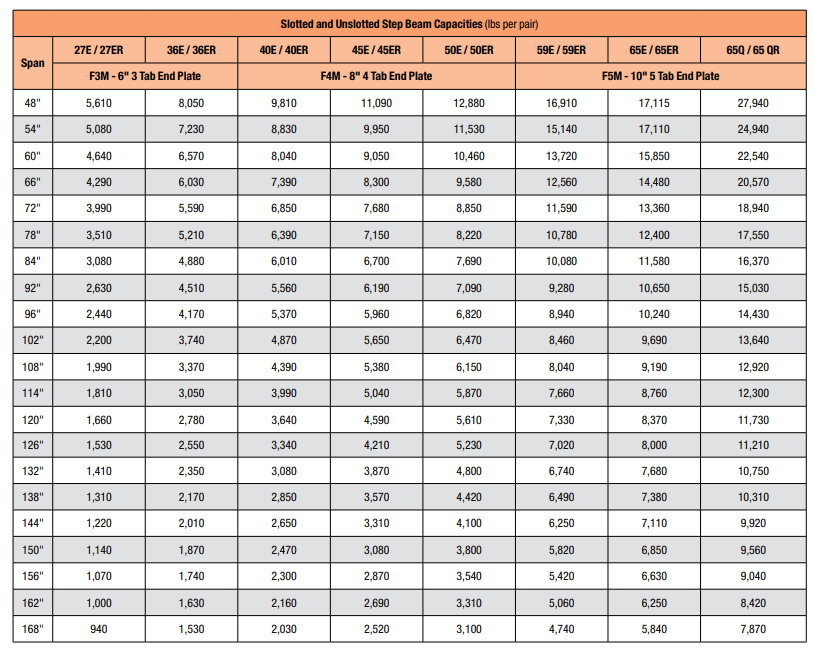
Pallet Rack Beam Capacity Charts
Pallet Rack Beam capacity is typically rated per pair of beams supporting one shelf level. In simple terms, the total weight stored on that level is shared across both beams.
Multiple factors affect beam capacity, including beam length, beam face height, beam profile design, steel thickness and the manufacturer’s engineering standards.
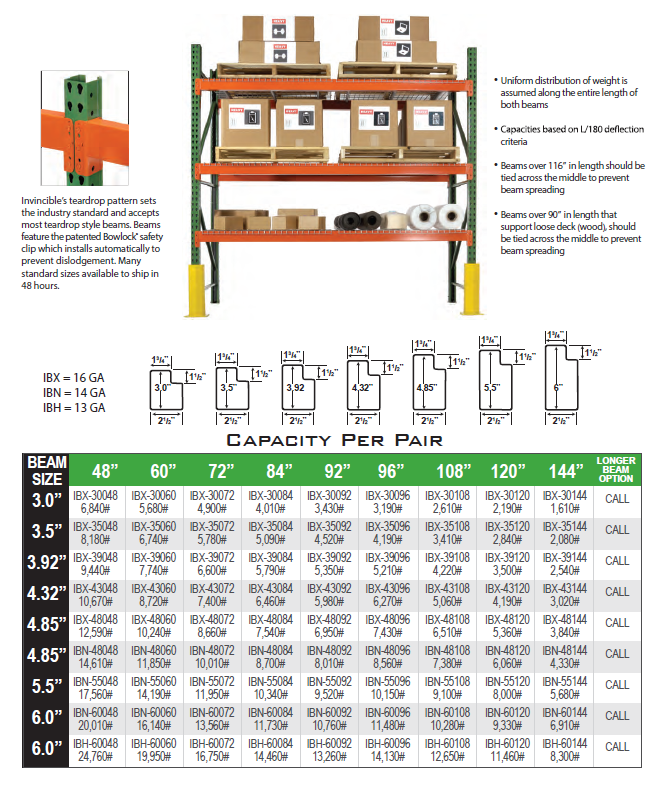
Understanding Beam Measurements
Pallet Rack Upright Capacity Charts
Pallet rack upright frame capacity involves more than frame height alone. The column design, bracing pattern, beam elevations, and overall installation conditions all contribute to the total allowable load of the frame.
One of the biggest factors is the design of the upright column itself. The bends formed into the column steel can dramatically increase strength while using the same gauge of metal. In simple terms, the more bends and formed shapes built into the column, the stronger and more efficient the design can become. This is why many uprights include bends, returns, or rear lips that may look unnecessary at first glance but are actually part of the structural design.
Whether the column is open back or closed back is another major factor. Closed column uprights, sometimes called tubular or boxed columns, generally provide significantly higher load capacities than open-back designs of similar size and gauge.
The two most common upright column sizes are 3 inch x 1-5/8 inch and 3 inch x 3 inch. Actual capacities can vary from manufacturer to manufacturer based on engineering methods, testing standards, steel specifications, and published load tables. It is not unusual for two uprights that appear nearly identical in size and shape to carry different rated capacities.
As manufacturing and engineering standards have improved, published upright ratings have become more refined and more accurate. Years ago, many people used rough rules of thumb such as assigning an 18,000 pound capacity to a 3 inch x 1-5/8 inch frame and 30,000 pounds to a 3 inch x 3 inch frame. Today, actual capacities should be based on the manufacturer’s specific load tables rather than broad estimates.
It may seem logical to assume a bolted upright would have a lower capacity than a welded upright, but that is not necessarily true. A large portion of upright strength comes from the column design itself, not just the horizontal or diagonal bracing between the columns.
Beam spacing is also an important factor in determining upright capacity. Because it is one of the most misunderstood topics in pallet rack design, we’ll cover beam spacing separately below.
Upright Beam Spacing Explained
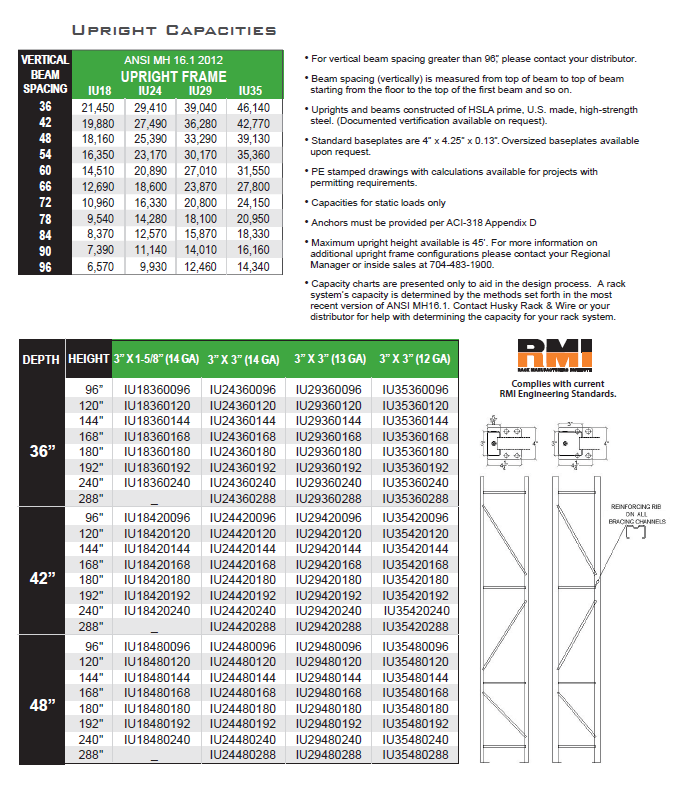
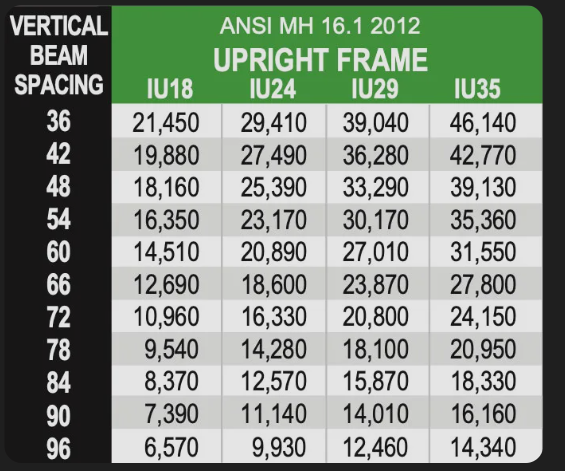
Beam spacing is one of the most important, and most misunderstood factors in pallet rack upright capacity. In simple terms, beam spacing refers to the vertical distance between beam levels, or the unsupported length of the upright column between the points where the beams tie the frame together.
A simple way to think about it is this… every beam level helps brace the upright frame. The more frequently the upright is supported, the stronger the frame becomes. Larger open spans between beam levels create more unsupported column length, which can reduce the published capacity of the upright.
Manufacturers use the maximum unsupported length when calculating upright capacities. That is usually the distance from the floor to the first beam level or the largest spacing between any two beam levels, whichever is greater. In many cases, that longest span becomes the controlling factor in the capacity chart.
For example, if your first beam level is set at 48 inches and the next level is 36 inches above it, the 48 inch span is typically the governing beam spacing. If you raise that first level to 60 inches, upright capacity may decrease because the unsupported column length has increased.
The opposite is also true. The lower the beam spacing, the higher a company may be able to publish the capacity of that same upright. A change from 48 inch spacing to 36 inch spacing can materially increase the stated rating, even when the upright, beam, and steel are otherwise identical.
This is where specifications can sometimes be misleading. Two suppliers may appear to be offering different capacities on paper, when in reality they are quoting the same upright under different beam spacing assumptions. Because many customers are unfamiliar with how beam spacing affects capacity, published numbers do not always tell the full story unless the spacing used in the rating is clearly stated.
As a general rule, tighter beam spacing can increase upright capacity, while wider beam spacing can reduce it. That does not mean beams should be placed randomly or too close together. Spacing still needs to match pallet heights, forklift clearance, and safe product handling.
The chart below is provided to help explain the concept of beam spacing as it related to upright capacities.
Can Existing Pallet Rack Be “Certified”?
WHEN REVIEWING PALLET RACK BEAM AND UPRIGHT CAPACITIES, THIS IS ONE OF THE MOST IMPORTANT TOPICS TO UNDERSTAND.
We receive this question regularly, especially from safety managers, warehouse supervisors, and facility leaders responsible for safe operations. It is also an important liability issue for larger companies that need documented standards, internal compliance, and confidence in the equipment being used.
When customers ask if we can certify the load ratings of their existing pallet rack, the answer depends on whether the exact manufacturer, model series, and original specifications of the uprights and beams are known. If that information is missing, the answer is NO.
We cannot certify unknown pallet rack, and no responsible company should claim they can based only on a site visit or visual inspection. Without verified engineering data, published load tables, and confirmed component identification, there is no legitimate way to assign an exact rated capacity after the fact.
This is also one of the biggest challenges in the used pallet rack market. The inability to verify or certify exact load ratings is often the single biggest limitation when buying, selling, or reusing existing systems.
The reality is that experienced professionals can sometimes make a reasonable estimate by comparing components to known rack designs and reference charts like those provided above. However, that is still only an educated estimate, not a verified or certified load rating.
This is where many people get understandably frustrated. They may own a warehouse full of existing rack or purchase a building that already contains pallet racking, and they naturally want to know what it can safely hold. Unfortunately, if the original product information is missing, that answer cannot be recreated with certainty years later.
We have even seen situations where companies purchased an entire warehouse of used pallet rack and later learned they could not obtain verified load ratings for the system. Once original documentation is gone, it is often gone for good.
Part of the challenge is that pallet rack components rarely carry clear identification marks, part numbers, or permanent manufacturer labels. Some manufacturers did this more consistently in the past, but it has never been universal across the industry.
This is an important concept to understand: existing or used pallet rack with unknown origin cannot be truly certified or definitively verified for exact load ratings after the fact.
What can be done is practical evaluation. Existing rack can often be inspected for visible damage, measured for compatibility, reconfigured with known components, or replaced with new rack that includes documented capacities. In many cases, that is the safest and most useful path forward.
How We Can Help
Even when certification is not possible, we can often help in practical ways, including:
- Identifying common rack styles
- Matching replacement beams or uprights
- Reviewing visible damage
- Planning rack additions or reconfiguration
- Supplying new pallet rack with documented capacities
- Recommending practical next steps for safe use
If you are unsure what your existing pallet rack can handle, we can help you evaluate the situation and recommend a safe, workable path forward.
Charts Are for Reference Only
The capacity charts on this page are intended for general estimating purposes only. They can be useful for comparing common beam and upright sizes, but actual capacities vary by manufacturer, model, steel gauge, connection style, and rack configuration.
Unless your rack matches the exact manufacturer and product series used to create the chart, the values shown should not be treated as certified load ratings. Always confirm final capacities before placing product into service.
Frequently Asked Questions
Are pallet rack beam capacities rated individually?
No. Beam capacity is typically rated per pair of beams supporting one shelf level.
Can used pallet rack still be safe?
Yes. Condition, configuration, and proper use all matter. However, exact capacities may not always be known.
Why do beam lengths matter?
Longer beams generally carry less weight than shorter beams of the same design.
Why does beam height matter?
Taller beam profiles are usually stronger and can often support higher capacities.
Can you help replace damaged rack components?
Yes. We regularly help customers source compatible replacement beams, uprights, decking, and accessories.
Need Help with Existing Pallet Rack?
If you need help identifying components, replacing damaged rack, or selecting new pallet rack with documented capacities, contact Midwest Material Handling for experienced, practical guidance.