

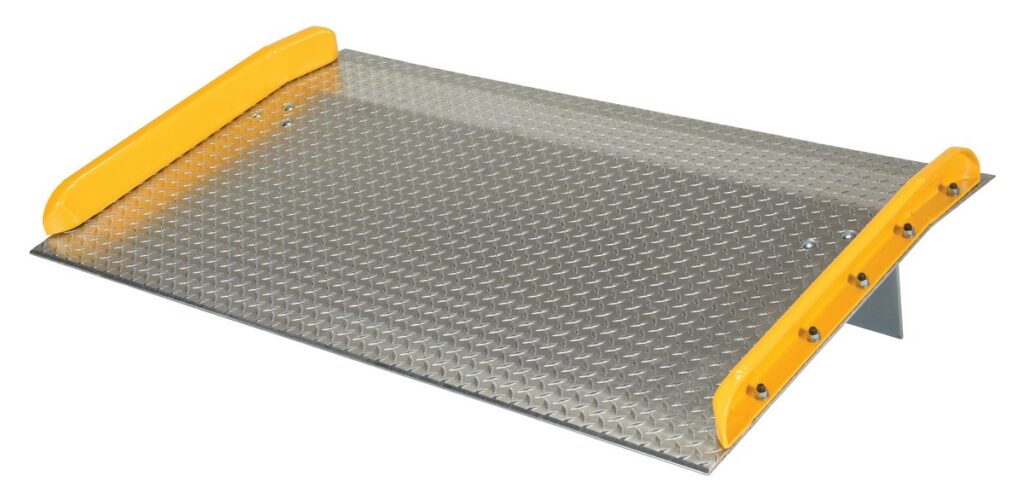

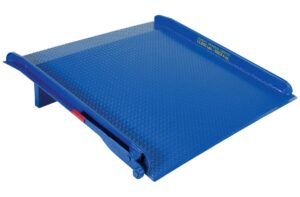
Dock Plate vs Dock Board: What’s the Difference?
We regularly hear from customers who need to safely bridge the gap between a loading dock and a semi trailer. At first glance, it seems simple. Some assume a thick steel plate placed between the dock and trailer will solve the problem.
That assumption can create serious safety risks.
Choosing between a dock plate and a dock board depends on how the equipment will be used, what type of traffic will cross it, and how much weight it must support. While the two products look similar, they are built for very different applications.
| Feature | Dock Plate | Dock Board |
|---|---|---|
| Material | Aluminum | Steel |
| Equipment Type | Hand carts, pallet jacks | Forklifts |
| Capacity Range | Light-duty | Heavy-duty |
| Weight | Lightweight | Heavier |
| Portability | Easy to move | Often moved by forklift |
| Best Use | Manual loading | Powered loading |
| Safety Legs | Yes | Yes |
| Typical Application | Light warehouse traffic | High-capacity loading docks |
The Main Difference Comes Down to Capacity
The biggest difference between a dock plate and a dock board is load capacity and equipment type. Dock plates are typically aluminum and designed for lighter duty use. Dock boards are engineered for forklift traffic and heavy loads.
Using the wrong one is not just inefficient. It can be unsafe.
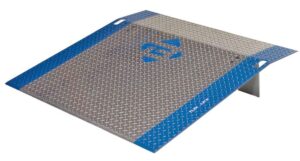
When to Use an Aluminum Dock Plate
Aluminum dock plates are best suited for non powered loading equipment such as:
-
Hand carts
-
Manual pallet jacks
-
Light material movement
They are lighter in weight, easier to position, and often include hand holes for portability.
Most aluminum dock plates include bolt on steel safety legs that sit between the dock and trailer to help secure the plate during use. They also feature diamond tread surfaces for traction and beveled edges for smoother transitions.
Typical sizes range from 30 to 84 inches wide and 24 to 84 inches long.
If forklifts are not crossing the gap and loads are moderate, a dock plate is often the appropriate solution.
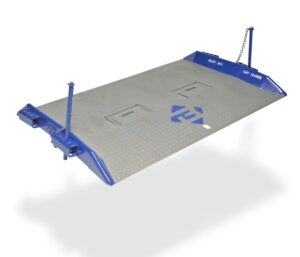
When a Steel Dock Board Is Required
Dock boards are designed for powered equipment and significantly higher capacities.
If a forklift will cross the dock gap, a dock board is generally required. Steel dock boards are constructed using welded steel and reinforced designs that support concentrated wheel loads. Many models offer capacities ranging from 15,000 to 40,000 pounds. They are available in wider and longer sizes than most dock plates and can be used in standard, refrigerated, container, and even below dock applications.
Unlike dock plates, dock boards are built to handle the stresses created by forklifts and heavy palletized loads.
Why You Should Never Use a Dock Plate for Forklift Traffic
Many loading dock accidents occur when equipment is used outside its intended application. Aluminum dock plates are designed for manual equipment and lighter wheel loads. Forklifts create concentrated wheel pressure that can exceed the design limits of a dock plate.
If powered equipment will cross between the dock and trailer, a properly rated steel dock board is typically required.
Measurements Needed to Select a Dock Plate or Dock Board
Before choosing a dock bridge, gather:
- Dock height
- Trailer bed height
- Width of the opening
- Type of equipment crossing
- Maximum combined equipment and load weight
These measurements help determine the proper length, width, capacity, and safety leg configuration.
Why Safety Legs and Height Differential Matter
Both dock plates and dock boards use safety legs to help secure the equipment between the dock and trailer.
However, the correct leg height and positioning depend on the height differential between the dock and the trailer deck. This measurement plays a critical role in determining the proper size and capacity needed.
Selecting the correct loading dock equipment involves more than matching width and length. Capacity and dock conditions must also be considered.
A Simple Way to Decide
Ask yourself three questions:
-
Will a forklift cross the gap?
-
What is the maximum combined weight of equipment and load?
-
How large is the height difference between dock and trailer?
If forklifts are involved, choose a dock board.
If loading is done manually or with pallet jacks only, an aluminum dock plate may be sufficient.
FAQ’s
Can a forklift drive across a dock plate?
In most cases, no. Dock plates are generally designed for manual equipment and lighter wheel loads. Forklift traffic typically requires a properly rated steel dock board.
What is the main difference between a dock board and a dock plate?
A dock plate is usually aluminum and intended for lighter-duty loading. A dock board is built from steel and engineered for forklift traffic and higher capacities.
How do I know what capacity I need?
The required capacity should include the weight of the equipment plus the maximum anticipated load crossing the dock.
Are dock plates and dock boards OSHA compliant?
Both can be used safely when properly selected, installed, and operated according to manufacturer specifications and loading dock safety practices.
Understanding the difference between a dock plate and a dock board helps prevent costly mistakes and improves dock safety. If you would like more detailed specifications, capacity guidance, or product options, you can explore our full dock equipment section for additional information.

Woah! I’m really enjoying the template/theme of this blog.
It’s simple, yet effective. A lot of times it’s very hard to get that “perfect balance” between user friendliness and appearance.
I must say you have done a awesome job with this. Also, the blog loads extremely quick for me on Chrome.
Exceptional Blog!