

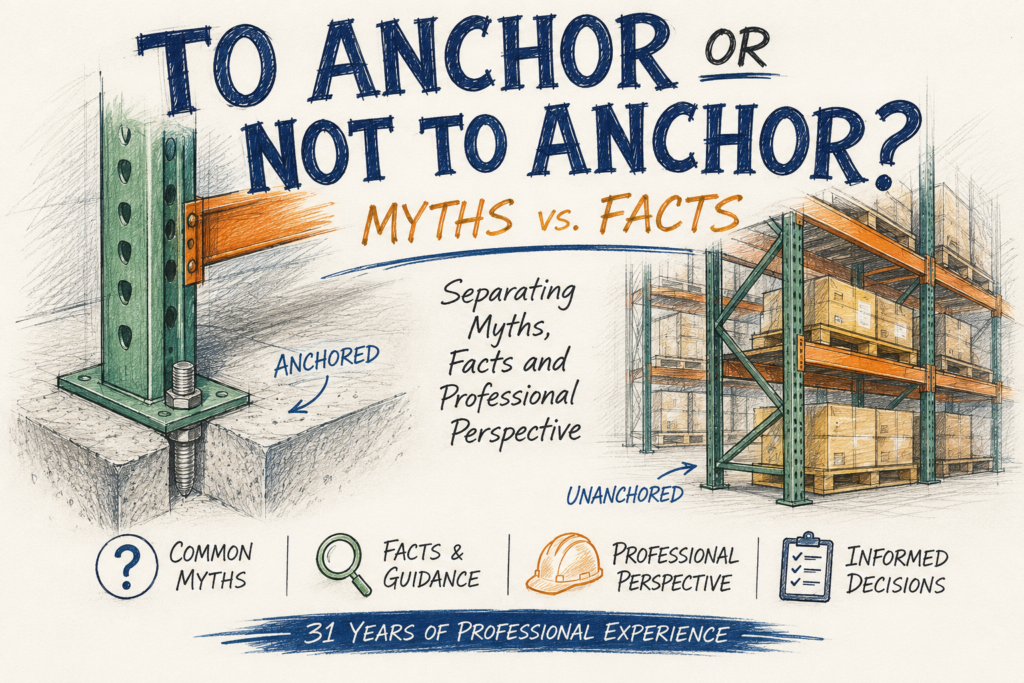

Does Pallet Racking Need to Be Anchored? Separating Myths, Facts & Professional Perspective
This is one of the most widely misunderstood topics we hear from warehouse owners, facility managers, installers and even professionals within the material handling industry. Few subjects generate more confusion than pallet rack anchoring because different regulations, standards and project requirements are often confused with one another.
The short answer is that it depends on which requirement you are referring to.
OSHA does not have a regulation that universally requires every pallet rack upright to be anchored. However, ANSI/RMI MH16.1, the nationally recognized engineering standard for industrial steel storage racks, generally requires rack columns to be anchored as part of the engineered rack design. In addition, rack manufacturers’ installation instructions, engineered drawings, seismic design criteria, local building codes and permit requirements may require anchoring for specific applications.
Much of the confusion stems from the fact that these requirements serve very different purposes and are enforced in very different ways. OSHA enforces workplace safety regulations. ANSI/RMI publishes nationally recognized engineering standards that are frequently referenced by manufacturers, engineers and code officials. Local building departments may enforce adopted building codes, while rack manufacturers require their products to be installed in accordance with their published instructions.
Understanding the difference between OSHA regulations, engineering standards, manufacturer requirements and local code requirements is the key to determining when pallet rack anchoring is actually required. At Midwest Material Handling, we’ve been designing, selling and installing pallet rack systems for more than 31 years. During that time, we’ve heard just about every argument for and against anchoring pallet rack.
This article isn’t intended to tell you there’s only one right answer. Instead, our goal is to separate common myths and fiction from documented facts and share our professional perspective based on more than three decades of installing and helping customers design warehouse storage systems.
Before We Begin…
Throughout this article, every statement falls into one of three categories…
MYTH
A commonly repeated belief or assumption we’ve heard from customers or throughout the material handling industry.
FACT
Information that can be verified through published regulations, manufacturer literature, engineering standards or other authoritative sources.
PROFESSIONAL PERSPECTIVE
Our professional judgment based on over 31 years of designing, selling and installing pallet rack systems and more than four decades of industry experience. Whenever we share our professional perspective, we’ll clearly identify it as such. Our goal isn’t to convince you to agree with every opinion we hold. Our goal is to help you separate myths from facts so you can make informed decisions for your own warehouse.
To ensure the factual portions of this article are accurate, we reviewed current OSHA guidance along with installation literature from several leading pallet rack manufacturers. Sources are noted below.
Myth #1… “OSHA requires every pallet rack installation to be anchored.”
FACT
This is probably the most common misconception in the pallet rack industry. There is no blanket OSHA regulation that states every pallet rack installation must be anchored to the concrete floor. That doesn’t mean anchoring is never required. Depending on the application, anchoring may be required by engineered drawings, seismic applications, local building codes, permit requirements or manufacturer installation instructions. Many people searching for “OSHA pallet rack anchor requirements” are surprised to learn that there is no blanket OSHA regulation requiring every pallet rack installation to be anchored.
This distinction is important because many people confuse OSHA regulations with manufacturer installation instructions, engineering requirements, seismic design and local building codes. They are not the same thing.
VERDICT
MYTH BUSTED
There is no blanket OSHA regulation requiring every pallet rack installation to be anchored.

Myth #2… “Manufacturers require every pallet rack installation to be anchored.”
FACT
This question isn’t as straightforward as many people believe. Many pallet rack manufacturers address anchoring in their installation manuals, but the language is not always identical. For example, the Interlake-Mecalux installation manual states that rack columns should be anchored using specified expansion anchors. UNARCO’s installation instructions state that when project specific anchoring details are not provided, the company recommends one anchor per column for standard pallet rack installations.
These examples demonstrate that manufacturers commonly recommend or suggest anchoring procedures within their installation literature. On engineered or permitted projects, anchoring requirements may also be established by the project drawings, the engineer of record or the local authority having jurisdiction. Following a manufacturer’s installation instructions may be necessary to comply with warranty requirements, engineered designs or project specifications, even though those instructions are separate from OSHA regulations.
PROFESSIONAL PERSPECTIVE
One of the reasons we wanted to write this article is because these distinctions often become blurred together. We frequently hear someone say, “You have to anchor pallet rack because OSHA requires it.” In reality, they may actually be referring to a manufacturer’s installation manual, an engineered drawing or a project requiring a building permit. These are generally requests and suggestions, not requirements.
Those are completely different sources of guidance. Understanding who is making the recommendation or requirement is an important part of evaluating any pallet rack installation.
VERDICT
Many manufacturers commonly “recommend” or “suggest” anchoring in their installation literature, rather than establishing a universal requirement. This terminology is important. However, projects in seismic regions, engineered installations and projects requiring building permits may have anchoring requirements that should always be followed.

Myth #3… “Anchoring pallet rack always makes it safer.”
FACT
Anchoring is intended to help resist movement at the base of the rack and may be required for certain applications, including engineered systems, seismic installations and projects subject to building permits. Whether anchoring improves overall safety depends on many factors, including rack height, frame depth, beam elevations, load distribution, seismic areas, operating conditions, forklift traffic and the specific application.
There is no single answer that applies to every warehouse.
PROFESSIONAL PERSPECTIVE
At Midwest Material Handling, we believe every warehouse deserves to be evaluated individually rather than applying the same solution to every installation. After 31 years of designing and installing pallet rack systems, we question whether permanently anchoring every standard warehouse installation provides a meaningful safety benefit in the vast majority of applications.
Every warehouse operates differently. Every rack configuration is different. Every customer has different operational needs.
Those differences should be considered before assuming every pallet rack installation benefits equally from concrete anchoring.
VERDICT
Anchoring can play an important role in certain applications. However, the belief that anchoring automatically makes every pallet rack installation safer is an oversimplification. The appropriate solution depends on the specific application, rack configuration and operating environment.
Myth #4… “Anchoring pallet rack has no downside.”
FACT
Anchoring pallet rack permanently alters the concrete floor. If the rack is relocated or removed, the anchor holes typically require repair. In leased facilities, repairing those holes is often the responsibility of the tenant and may affect the return of a security deposit if the floor is not restored to the landlord’s satisfaction. The floor can rarely be restored to the pre-anchor condition.
Every time a rack layout is changed, anchored uprights require the anchors to be removed, new holes drilled and the original holes repaired. Those are real costs that should be considered before deciding whether to anchor a pallet rack system.
PROFESSIONAL PERSPECTIVE
One of pallet rack’s greatest advantages is that it’s a modular storage system, commonly referred to throughout the material handling industry as component racking. Unlike permanent shelving, pallet rack is designed to be expanded, reduced, relocated and reconfigured as a business grows and warehouse operations evolve. Tools are not even needed to install it.
In our experience, warehouse layouts rarely remain the same for long. Inventory and workflow changes. Product lines expand. New equipment is introduced. Shipping and receiving departments are relocated. Businesses are constantly adjusting their storage systems to improve efficiency.
Every time a permanently anchored rack system is relocated, the anchors must be removed, new holes drilled and the old holes repaired. In leased facilities, those repairs often become the tenant’s responsibility and, in some cases, may result in the loss of part or all of a security deposit if the floor isn’t restored to the landlord’s satisfaction.
In our opinion, permanently anchoring pallet rack changes it from component racking into a semi permanent building fixture. That runs counter to one of the primary reasons businesses choose pallet rack in the first place… the ability to adapt as their warehouse changes.
VERDICT
Anchoring offers benefits in certain applications, but it also comes with tradeoffs. Permanently altering the concrete floor, increasing the effort required to reconfigure warehouse layouts and creating potential repair costs are all factors that should be considered before deciding whether to anchor a pallet rack system.
Myth #5… “Unanchored pallet rack will slide, shift or tip over under normal warehouse use.”
FACT
The stability of a pallet rack system depends on many factors, including rack height, frame depth, beam elevations, load distribution, the number of interconnected sections, floor conditions, forklift traffic, seismic considerations and whether the installation has been engineered for a specific application. There is no single factor that determines the stability of every pallet rack installation.
PROFESSIONAL PERSPECTIVE
For more than 31 years, Midwest Material Handling has been designing, selling and installing pallet rack systems. As additional rack sections are connected together and a significant amount of product is added, the overall stability of the rack system increases. In our professional judgment, once an interconnected rack system is carrying a meaningful amount of inventory and weight, it becomes extremely difficult for the rack to move under normal warehouse operating conditions. Of course, a forklift hitting it at a normal speed is the exception to the rule.
This perspective does not apply to every application. Exceptionally tall rack systems, shallow frame depths, seismic applications, engineered installations, single or individual rack sections and projects requiring building permits should always be evaluated on their own merits.
VERDICT
The belief that an unanchored pallet rack system will naturally slide, shift or tip over during normal warehouse operations is an oversimplification. Stability depends on the specific application, not simply on whether the rack is anchored.
Myth #6… “If a forklift hits an anchored upright, it’s always safer because the rack can’t move.”
FACT
Pallet rack is not designed to be struck by forklifts. Forklift impacts can damage rack uprights whether they are anchored or unanchored. The extent of the damage depends on many factors, including the speed and angle of impact, the weight of the forklift, the rack configuration and the severity of the collision.
PROFESSIONAL PERSPECTIVE
This is one of the most debated topics in the pallet rack industry. In our professional judgment, it’s reasonable to ask whether a rigidly anchored upright always performs better during a minor forklift impact than one that has the ability to move slightly as part of an interconnected, heavily loaded rack system.
We have not found published testing that conclusively demonstrates that a rigidly anchored upright always experiences less damage during every type of forklift impact than an interconnected rack system that is not anchored. We’re not suggesting that unanchored rack is better. We’re suggesting the answer isn’t always as simple as many people assume.
VERDICT
There is no simple answer.
Forklift impacts are influenced by many variables, and it is difficult to conclude that anchoring alone determines the outcome. Every application should be evaluated based on its specific operating environment and risk factors.
What is ANSI/RMI MH16.1?
One point of confusion is the role of ANSI/RMI MH16.1. ANSI/RMI is not a government agency and its standards are not OSHA regulations. Rather, ANSI/RMI MH16.1 is the nationally recognized consensus engineering standard used by pallet rack manufacturers and engineers for the design, testing and utilization of industrial steel storage racks.
Nearly every major pallet rack manufacturer designs its products around this standard, and installation instructions are generally written to comply with its requirements. While ANSI/RMI itself is not law, it represents the engineering standard that much of the pallet rack industry follows.
Conclusion
Should pallet rack be anchored? Like many questions in the material handling industry, the answer depends on the specific application and the requirements that apply to your project. While OSHA does not have a regulation that universally requires every pallet rack upright to be anchored, ANSI/RMI MH16.1, manufacturer installation instructions, engineered drawings, seismic design requirements, local building codes and permit requirements may require anchoring for many installations. Those requirements should always be followed.
One of the biggest sources of confusion is that OSHA regulations, ANSI/RMI engineering standards, manufacturer installation instructions and local building codes are often treated as though they are the same thing. They are not. Each serves a different purpose, and understanding which requirements apply to your facility is essential when designing or modifying a pallet rack system.
Every warehouse is different. Every rack configuration is different. Factors such as rack height, load capacity, forklift traffic, seismic conditions, engineered design, manufacturer specifications and local code requirements should all be considered before making decisions about pallet rack anchoring.
At Midwest Material Handling, our goal isn’t to promote or discourage anchoring. Our goal is to help customers understand the facts, separate common misconceptions from documented requirements and design warehouse storage systems that are safe, practical and appropriate for their specific application. The best pallet rack installation isn’t the one that follows internet myths. It’s the one that follows applicable regulations, recognized engineering standards, manufacturer requirements and sound professional judgment.
Frequently Asked Questions (FAQ’S)
Does OSHA require pallet rack to be anchored?
No. OSHA does not have a blanket regulation requiring every pallet rack installation to be anchored. However, engineered drawings, building codes, permit requirements or manufacturer installation instructions may require anchoring for specific applications.
Does ANSI/RMI require anchoring?
Yes. ANSI/RMI MH16.1 states that rack columns are to be anchored to the floor as part of the rack’s engineered design. The standard also includes limited exceptions for certain hand loaded storage racks when approved by a registered design professional. For typical forklift served pallet rack systems, anchoring is considered part of the engineered installation.
Are pallet rack anchors always required?
No. Requirements vary depending on the manufacturer, engineering requirements, building codes and the specific application.
When should pallet rack be anchored?
Anchoring is commonly appropriate for engineered installations, seismic applications, projects requiring building permits and other situations where anchoring is specified by the manufacturer, engineer or authority having jurisdiction.
Does anchoring make pallet rack safer?
Not always. It can in certain applications. However, whether anchoring improves safety depends on many factors including rack configuration, loading, operating conditions and the specific installation.
What size concrete anchors does Midwest Material Handling typically use?
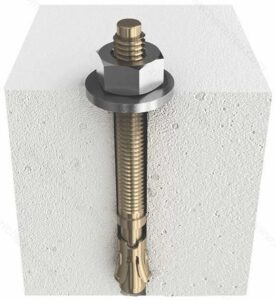
When anchoring is required, we typically install 1/2 inch x 4 1/2 inch wedge anchors, unless project specifications or engineering requirements call for something different.
Can pallet rack uprights be anchored later?
Yes. Many warehouse owners install pallet rack first and anchor it later if engineering requirements, permitting or operational changes make anchoring appropriate.
Whether you’re installing a single row of pallet rack or designing an entire warehouse, every project deserves to be evaluated on its own merits. If you’re unsure whether anchoring is appropriate for your application, our team can help. With more than 31 years in business and decades of industry experience, Midwest Material Handling can recommend a storage solution based on your facility, your workflow and the applicable guidelines, not assumptions or myths.
Sources & References
The factual information in this article is based on published OSHA guidance, manufacturer installation literature and applicable engineering and building requirements. The Professional Perspective sections reflect Midwest Material Handling’s experience gained from more than 31 years in business and more than 40 years in the material handling industry.
References:
- Occupational Safety and Health Administration (OSHA)
- Husky Rack & Wire Installation Instructions
- Interlake Mecalux Installation Manual
- Steel King Assembly Guide
- UNARCO Installation Instructions
- Applicable engineering drawings, local building codes and permit requirements
- Rack Manufacturers Institute (RMI) engineering standards and technical publications*
*RMI is an industry trade association, not a regulatory agency. Its publications are widely referenced by manufacturers, engineers and the material handling industry but are not, by themselves, legal requirements.
