


Do You Need a Permit for Pallet Racking in Ohio? Here are the Facts.
If you’re installing pallet racking in Ohio, you’ve probably heard completely different answers about permits. Some companies say you always need one. Others say you dont.
After 31+ years selling and installing pallet racking across Ohio, here’s the reality: Most standard pallet racking installations never go through a formal permit process.
But there’s a reason for the confusion, it comes down to how the fire code is written versus how it’s actually applied in the real world.
This guide breaks down both.
How It Actually Works in the Real World
Across most of Ohio, pallet racking projects are installed without formal permits.
That’s not because there isn’t a fire code. There is. It’s because most standard warehouse setups don’t trigger the conditions that typically lead to review.
Where things change is when storage height, product type, or layout increases fire risk. That’s when a project is more likely to get attention from a fire official.
What the Fire Code Says (And Why It Matters)
Ohio follows the Ohio Fire Code, which is based on the International Fire Code (IFC).
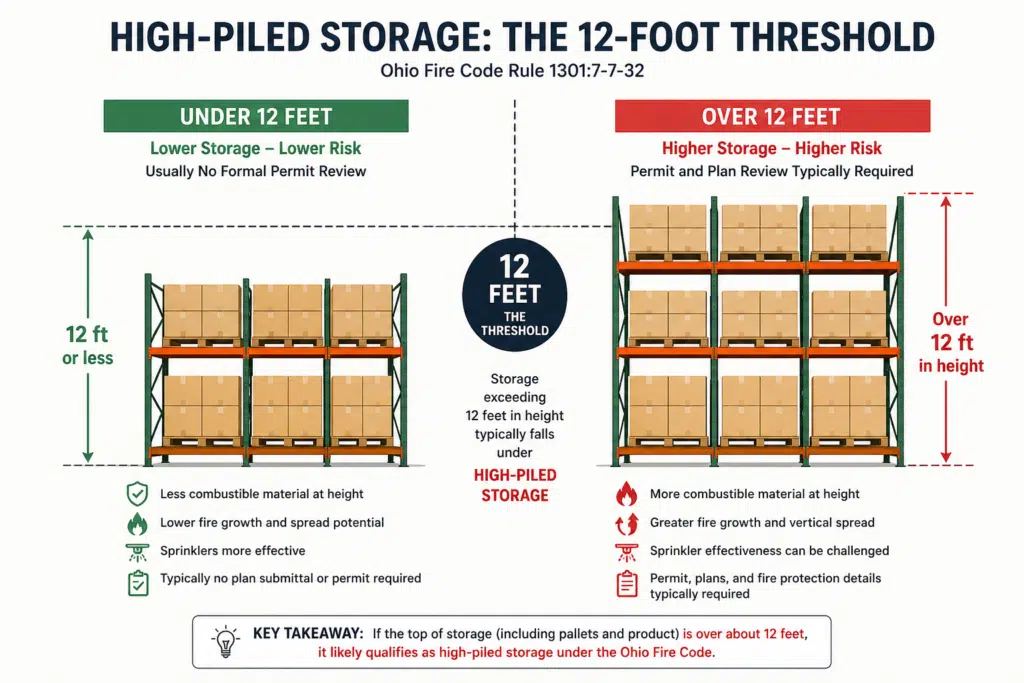
The part that affects pallet racking is called high-piled storage. This generally refers to storing combustible materials where the top of storage exceeds about 12 feet. The code outlines additional requirements, including permits and plan review, for those conditions.
Here’s the part most people misunderstand: It’s not about how tall your rack is… it’s about how high your product is stored.
Real-World Examples
- A 20-foot rack storing product at 10 feet → typically not high-piled storage
- A 10-foot rack storing product at 13 feet → considered high-piled storage
The fire code is focused on fuel load, vertical fire spread, and sprinkler performance, not the steel itself.
Why the 12-Foot Threshold Matters
As storage height increases, fire behavior changes. Heat builds faster. Fire spreads vertically more aggressively. Sprinkler systems become more sensitive to layout and clearance.
That’s why projects with taller storage are more likely to be reviewed, especially if other risk factors are present.
When a Project Is More Likely to Be Reviewed
Most installations don’t draw attention. But certain conditions make review more likely:
- Storage heights approaching or exceeding about 12 feet
- Plastic or higher-risk commodities
- Layouts that impact sprinkler performance
- Larger systems or major layout changes
These are not automatic triggers, they’re the situations where a fire official is more likely to take a closer look.
Why It Varies by Location
The fire code itself is consistent across Ohio. What varies is enforcement.
Some areas, especially those with a high concentration of distribution and warehouse facilities, like Groveport Ohio and parts of Columbus, tend to review projects more closely. Other areas are less hands-on unless something stands out.
Same code. Different levels of scrutiny.
What Inspectors Actually Care About
If a project does get reviewed, the focus is usually on:
- Flue spacing
- Aisle widths
- Commodity classification
- Sprinkler clearance
- Anchoring and overall layout
These are the same factors that should already be addressed in a properly designed rack system.
A Practical Rule of Thumb
If your storage is relatively low and straightforward, you will likely never deal with a formal permit process.
If your storage is taller, involves plastics, or interacts heavily with your sprinkler system, it’s worth taking a closer look.
Not because you automatically need a permit, but because those are the situations where questions tend to come up.
Quick Checklist: Will Your Project Get Reviewed?
Most projects never check these boxes, but when they do, that’s when questions usually come up.
- Is your stored product approaching or exceeding about 12 feet?
- Are you storing plastics or higher-risk materials?
- Does your layout impact sprinkler clearance or flue space?
- Is this a large installation or a major layout change?
If you answered no to all of these, your project will likely never go through a formal permit process.
If you answered yes to one or more, it doesn’t mean you automatically need a permit, but it does mean your project is more likely to get a closer look.
How to Check Your Situation
You don’t need to overcomplicate it. If your storage height is approaching 12 feet, if you’re installing new racking, or if your layout affects fire protection, a quick call to your local fire department or building department can usually give you clarity.
So I have Determined I Need a Permit, What is Involved?
If your project does fall into a category that requires review, the process is usually straightforward, but it does involve a few key steps.
1. Layout Submission
You’ll provide a scaled layout (generally a CAD drawing) showing rack configuration, heights, aisle spacing, and building layout.
2. Product & Storage Details
You’ll need to define what you’re storing, how it’s packaged, and how high it’s stored. Fire code requirements are based on commodity type and storage height — not just the rack itself.
3. Fire Protection Review
This is typically the most important step. The review focuses on sprinkler compatibility, flue spacing, clearances, and overall layout.
4. Engineering (If Required)
Some projects require stamped drawings, anchoring details, or load information depending on size and height.
5. Plan Review & Approval
Your local fire or building department reviews the submission and may approve it or request adjustments.
6. Installation & Inspection
Once approved, the system is installed and may be inspected to confirm it matches the approved plan.
→ NOTE: Remember, most standard installations never go through this process… they simply don’t trigger these conditions.
FAQ: Pallet Racking Permits in Ohio
Do you need a permit for pallet racking in Ohio?
Most of the time, no. Standard installations typically do not go through a formal permit process. However, certain storage conditions may lead to review.
What is high-piled storage?
Storage of combustible materials where the top of storage exceeds about 12 feet.
Why do some areas seem stricter than others?
The code is the same statewide, but enforcement varies. Areas with more warehouse activity tend to review projects more closely.
Do I need a permit if my racking is under 12 feet?
Usually not, although other factors like product type and sprinkler interaction can still matter.
Who decides if a permit is required?
Your local authority having jurisdiction, typically the fire marshal or building department.
Need Help Figuring It Out?
If you’re not sure where your project falls, we can help. Send us your layout and we’ll tell you whether it’s likely to trigger review… before it becomes a problem.
If you’re still in the planning phase, we can design your system to align with fire code requirements and avoid surprises.
We’ve been installing pallet racking across Ohio for more than 31 years. If something needs attention, we’ll tell you. If it doesn’t, we’ll let you know also.
Final Takeaway…
In real-world practice, most pallet racking installations in Ohio move forward without a formal permit process.
The fire code comes into play when storage height, materials, and layout increase fire risk, and those are the situations where a project is more likely to be reviewed.
