
Steel industrial ladders are a practical solution for warehouses, retail facilities, distribution centers and manufacturing operations where employees need safe access to elevated shelving and storage. Unlike a conventional step ladder, an industrial steel rolling ladder is designed to be moved around the facility and typically includes wheels or casters, a larger standing platform and a locking system for stability during use.
Midwest Material Handling sells a full range of steel rolling ladders, including 4-step models for everyday warehouse access and taller rolling ladders for reaching higher shelving and storage areas. Whether you are replacing an existing warehouse ladder or outfitting a new facility, choosing the right height, tread style and safety features can make a significant difference in how the ladder performs. Steel rolling warehouse ladders fall within our broader material handling equipment family of products.
Steel Rolling Ladders Used by Customers Nationwide
Our steel rolling ladders are used by customers throughout the United States, including BJ’s Wholesale Club locations nationwide.
Supplying a large national retailer requires consistent product quality, dependable availability and the ability to coordinate freight to multiple locations. Our experience supplying BJ’s Wholesale Club is another example of how our steel rolling ladders are used in demanding commercial and warehouse environments.
Whether you need a single rolling ladder for a local warehouse or multiple ladders for facilities across the country, Midwest Material Handling can help with product selection, pricing and nationwide freight.
4-Step Steel Rolling Ladder for Multi-Level Shelving
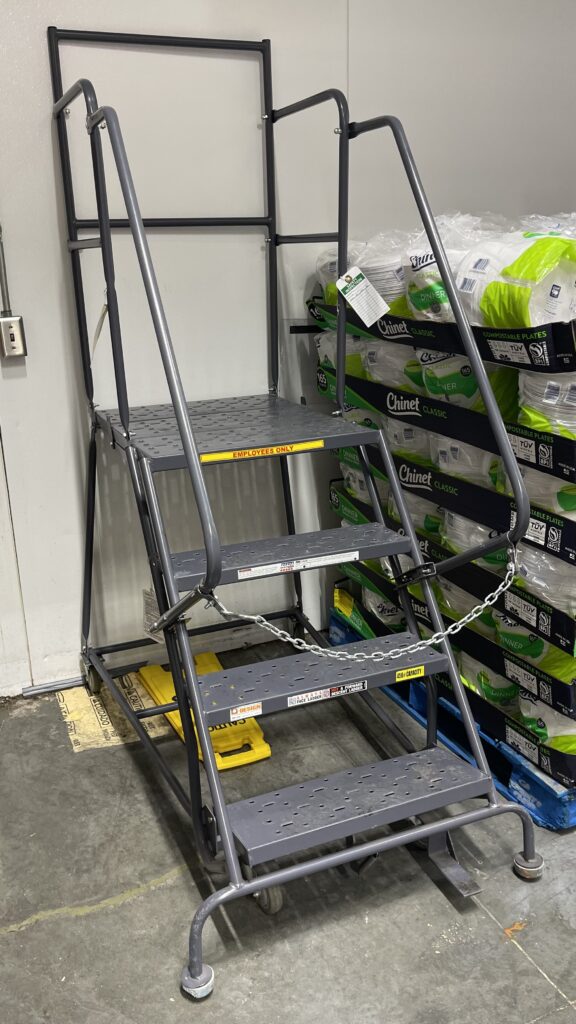
BJ’s Wholesale Club was looking for a mobile steel rolling ladder that could safely reach multiple levels of shelving while improving employee safety and efficiency. The customer had several specific requirements. They wanted a larger top platform, wider step treads and additional safety features to help reduce the possibility of slips or improper use. They also requested a safety chain to prevent the ladder from being used while it was stored. For additional stability during operation, they wanted a self-locking bottom step using the Saf-T-Lock system.
We worked with Tri-Arc Manufacturing to develop a steel rolling ladder that met the customer’s requirements. The initial ladder was provided as a trial unit so the customer could evaluate it in their actual warehouse environment. After several weeks of daily use, the customer was confident in the ladder’s design, stability and performance. BJ’s Wholesale ultimately purchased 26 identical steel rolling ladders, which were shipped to multiple warehouse club locations throughout the United States.
This project illustrates why choosing a rolling ladder is about more than simply selecting the number of steps. Platform size, tread design, working height, caster configuration and locking system all need to match the application.
Steel Rolling Ladder Options
Steel rolling ladders are available in several configurations to accommodate different warehouse and industrial environments. The right configuration depends on how the ladder will be used, the conditions in the facility and the height employees need to reach.
2-4 Step Steel Rolling Ladders
A 2-4 step steel rolling ladder is one of the most popular choices for everyday warehouse applications. These shorter rolling ladders are useful for accessing shelving, picking inventory and reaching products stored above normal working height. For facilities where employees frequently move between storage locations, a rolling ladder provides a convenient alternative to carrying and repositioning a conventional step ladder.
Taller Steel Rolling Ladders
Taller rolling ladders are designed for applications where employees need to reach higher shelving and storage areas. Models with 8, 10, 12, 14 or more steps can provide the additional working height required for taller warehouse shelving and multi-level storage applications. When selecting a taller rolling ladder, it is especially important to consider the platform height and the actual working height required rather than choosing a ladder based solely on the number of steps.
Grip Strut vs. Perforated Steel Steps
One of the most important options to consider when purchasing a steel rolling ladder is the type of step surface.
Grip Strut Steps
Grip Strut expanded metal steps provide excellent slip resistance and are a good choice for demanding industrial environments. The open design allows liquids, dirt and debris to pass through the tread rather than collecting on the walking surface. Grip Strut is particularly well suited for applications where employees may encounter wet, oily or slippery conditions.
Perforated Steel Steps
Perforated steel steps, also known as Perf Tread, provide a durable and slip-resistant walking surface for general warehouse and industrial applications. Perf Tread is an economical alternative to Grip Strut while still providing the strength and durability needed for everyday use. The best tread option depends on the environment where the ladder will be used and the level of slip resistance required.
Standard Rolling Ladder Safety Features
Industrial rolling ladders can be configured with several features designed to improve stability and make positioning easier.
Depending on the model, available features can include:
- Spring-loaded casters
- Saf-T-Lock foot-pedal locking systems
- Safety chains
- Wider step treads
- Larger top platforms
- Slip-resistant step surfaces
- Different ladder heights and configurations
Spring-loaded casters allow the ladder to roll easily when it is being positioned. When an employee steps onto the ladder, the casters retract so the ladder rests securely on its feet. The Saf-T-Lock system provides another method of securing the ladder. A foot pedal allows the operator to engage the locking mechanism before climbing. Safety chains can also be added to certain configurations to help prevent unauthorized or unintended use when the ladder is stored.
How to Choose the Right Steel Rolling Ladder
The correct rolling ladder depends on more than just the number of steps. Before purchasing a ladder, consider the following:
Working Height
Determine how high employees need to reach and where their feet will be positioned while performing the task.
Platform Size
A larger top platform can provide additional standing space and may be particularly useful when employees need to work at an elevated location rather than simply reach an item.
Step Width
Wider steps can provide additional footing and may be preferable for applications involving frequent use.
Tread Surface
Choose between Grip Strut and perforated steel steps based on the conditions in your facility and the level of slip resistance required.
Locking System
Consider how the ladder will be positioned and secured during use. Spring-loaded casters and Saf-T-Lock systems are two common configurations.
Frequency of Use
A ladder that will be used dozens of times each day should be selected with durability, ease of movement and employee ergonomics in mind. If you are unsure which rolling ladder is right for your application, we can help you compare the available configurations.
Steel Rolling Ladders for Warehouses
Rolling warehouse ladders are commonly used for inventory picking, order fulfillment, shelving access, maintenance and general warehouse operations. They are particularly useful in facilities where employees need to reach products stored above normal standing height but do not need a forklift or other powered equipment for the task.
Because rolling ladders can be moved between storage aisles and work areas, one ladder can often serve multiple locations throughout a facility. For high-use applications, an industrial-grade steel rolling ladder provides the durability needed for demanding warehouse environments.
Steel Industrial Ladders for Manufacturing, Retail & Distribution
Steel rolling ladders are also used in manufacturing plants, distribution centers, retail locations, maintenance departments and other industrial facilities. The appropriate configuration depends on the working environment. For example, facilities with wet or oily conditions may benefit from Grip Strut treads, while general warehouse applications may be well suited to perforated steel steps.
Higher-access applications may require a taller ladder with a larger top platform and an appropriate locking system. We can help you determine which configuration makes sense for your facility and the work employees need to perform.
Steel Rolling Ladder Freight and Shipping
Freight is an important consideration when purchasing a steel rolling ladder. Although some ladders weigh as little as 125 pounds, their overall dimensions can take up considerable space in a freight trailer. Even ladders shipped knocked down, or KD, can have a relatively large freight footprint.
Depending on the size and configuration, rolling ladders may ship at freight classes in the 200 to 400 range. That means freight can represent a significant portion of the total delivered cost, particularly when purchasing a single ladder. We work closely with our 3PL freight partners to obtain competitive shipping rates and reliable delivery throughout the United States.
If you are purchasing multiple rolling ladders or shipping to multiple locations, we can help coordinate the freight and provide a delivered shipping quote.
American-Made Steel Rolling Ladders
All of the steel rolling ladders we sell are proudly manufactured in the United States. We offer a variety of heights, step configurations and safety options to accommodate different warehouse and industrial applications. From a compact 4-step rolling ladder for everyday shelving access to a taller 14-step model for elevated storage, we can help you find a configuration that fits your application.
Frequently Asked Questions About Steel Rolling Ladders
What is a steel rolling ladder?
A steel rolling ladder is an industrial ladder equipped with wheels or casters so it can be moved around a warehouse or facility. Most models include steps, handrails or guardrails and a top platform for accessing elevated storage.
What are steel rolling ladders used for?
Steel rolling ladders are commonly used for accessing warehouse shelving, inventory, elevated storage and equipment. They are also used in manufacturing, distribution and maintenance applications.
What is the difference between a rolling ladder and a step ladder?
A rolling ladder is designed to be moved around a facility and typically includes casters, a larger standing platform and a locking system. A conventional step ladder is generally designed to be carried and repositioned manually.
How many steps should a rolling ladder have?
The appropriate number of steps depends on the height you need to reach and the platform height of the ladder. A 4-step rolling ladder is commonly used for everyday warehouse access, while taller models are available for higher shelving and storage areas.
Are steel rolling ladders safe?
Industrial rolling ladders are designed with features such as slip-resistant treads, stable support structures and locking systems. Always follow the manufacturer’s instructions and applicable workplace safety requirements when using a rolling ladder.
What is Grip Strut on a rolling ladder?
Grip Strut is an expanded metal tread designed to provide excellent slip resistance. Its open design allows liquids and debris to pass through the tread, making it a good option for wet, oily or demanding industrial environments.
What is Perf Tread?
Perf Tread is a perforated steel walking surface that provides a durable, slip-resistant tread for rolling ladders. It is commonly used in general warehouse and industrial applications.
Are steel rolling ladders made in the USA?
Yes. All of the steel rolling ladders we sell are proudly manufactured in the United States.
Can you ship rolling ladders?
Yes. We ship steel rolling ladders throughout the United States and work with freight partners to obtain competitive shipping rates. Because rolling ladders can have a large freight footprint, we recommend getting a freight quote before ordering.
Need an Industrial Ladder for Your Facility?
Whether you need a 4-step steel rolling ladder for everyday warehouse access or a taller industrial rolling ladder for elevated shelving, Midwest Material Handling can help you find the right configuration.
We can help you select the appropriate ladder height, tread style, platform configuration and safety features for your application.
Contact Midwest Material Handling for current pricing, availability and a freight quote on steel rolling ladders.
